
Nottingham's Manufacturing Heritage: What the City Built, and What It's Building Now
Nottingham gets remembered for lace. Robin Hood. Brian Clough. What tends to get glossed over is that this city has been making things, seriously making them, for well over four centuries. Long before the phrase "advanced manufacturing" entered anyone's vocabulary, Nottingham was figuring out how to mechanise production at scale, and the consequences of that early industriousness still ripple through the regional economy today.
It's a story worth telling properly, partly because the heritage is genuinely interesting, and partly because what the city is building right now picks up those same threads in ways that aren't always obvious from the outside.
Where It Started: The Frame That Changed Everything
The most useful place to begin is a village just outside Nottingham, in 1589. William Lee of Calverton invented the stocking frame, a knitting machine that could produce hosiery roughly a hundred times faster than hand knitting. Queen Elizabeth I, famously, was not impressed. She refused to grant him a patent, worried it would put hand-knitters out of work. Lee eventually took his invention to France.
The technology came back. And when it did, it took root in Nottinghamshire in a way that shaped the region's character for the next three hundred years.
By the 18th century the hosiery trade had made Nottingham one of the most industrially significant towns in England. Then came the pivot. Men's fashion shifted from knee breeches and stockings towards trousers, and suddenly the demand for hosiery

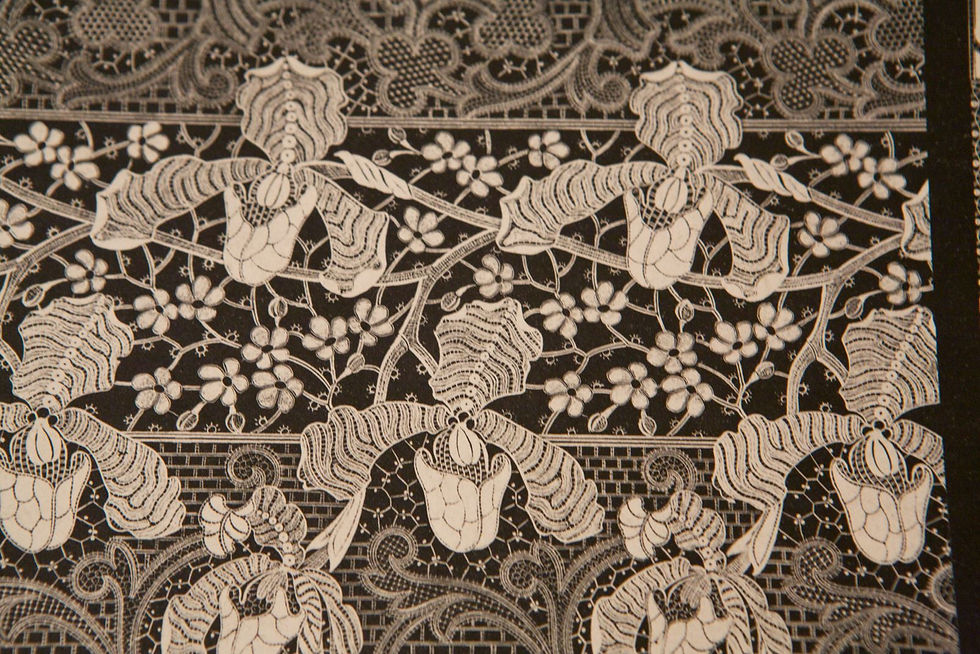
collapsed. Many of the same workers and frameworkers turned their skills to lace, and the Lace Market as we now know it grew out of that adaptation. What looks today like a neighbourhood of handsome Victorian warehouses and converted flats was once the commercial nerve centre of a global industry.
At its peak in the 1890s, the lace trade employed something in the region of 25,000 mostly female workers across Nottinghamshire. More than 90% of all warp and twist lace machines operating anywhere in the world were manufactured in the Nottingham area. The city wasn't just making lace. It was making the machines that made the lace, and selling both to the world.
The industry contracted sharply after the First World War, a victim of changing fashion, the devastation of export markets, and the wider economic slump of the 1920s. By the late 20th century only a handful of lace producers remained. But the instinct that produced those workers and frameworkers, the willingness to adapt, to retool, to find a new application for existing skills, didn't go anywhere.
The Companies That Defined a City
Nottingham's industrial history didn't stop with textiles. The city became home to businesses that, in some cases, grew into global names.
Jesse Boot opened a herbalist shop in Nottingham in 1849. His son Jesse turned it into a pharmaceutical operation that eventually occupied a swathe of island Street and then a vast purpose-built campus at Beeston, designed in the 1930s by the engineer Owen Williams. Those Beeston buildings, the D10 "Wets" factory and the D6 "Drys" building, are now listed structures, considered among the most significant examples of Modernist industrial architecture in Britain. Boots became one of only four UK companies approved by the British Medical Research Council to manufacture insulin. A herbalist's shop, turned into a pharmaceutical manufacturer, turned into a national institution. That's quite a trajectory for one family from Nottinghamshire.
Around the same time, Raleigh was building bicycles in the city, eventually becoming one of the largest bicycle manufacturers in the world. John Player and Sons were running tobacco operations that, at their height, employed thousands of Nottingham residents. These weren't niche operations. They were, for a time, genuinely world-scale manufacturing enterprises based in a medium-sized East Midlands city.
The Royal Ordnance Factory and the Craft of Precision Engineering
There's a less celebrated part of Nottingham's industrial story that tends to get overlooked: the city's role in British defence manufacturing.
The National Projectile Factory opened in Nottingham during the First World War on a site at King's Meadow, producing artillery shells under the management of Cammell, Laird and Company. By June 1918 it had produced nearly 900,000 shells. The site later became the Royal Ordnance Factory, which opened in its formal configuration in 1936 in the Meadows, employing up to 4,000 workers during the Second World War. It operated until 2001.
For people who trained there, the Royal Ordnance Factory wasn't just a workplace. It was a school in the most practical sense. The precision tolerances, the material disciplines, the understanding of mechanical systems under pressure: these were skills acquired through structured apprenticeship programmes that placed real demands on anyone who went through them.
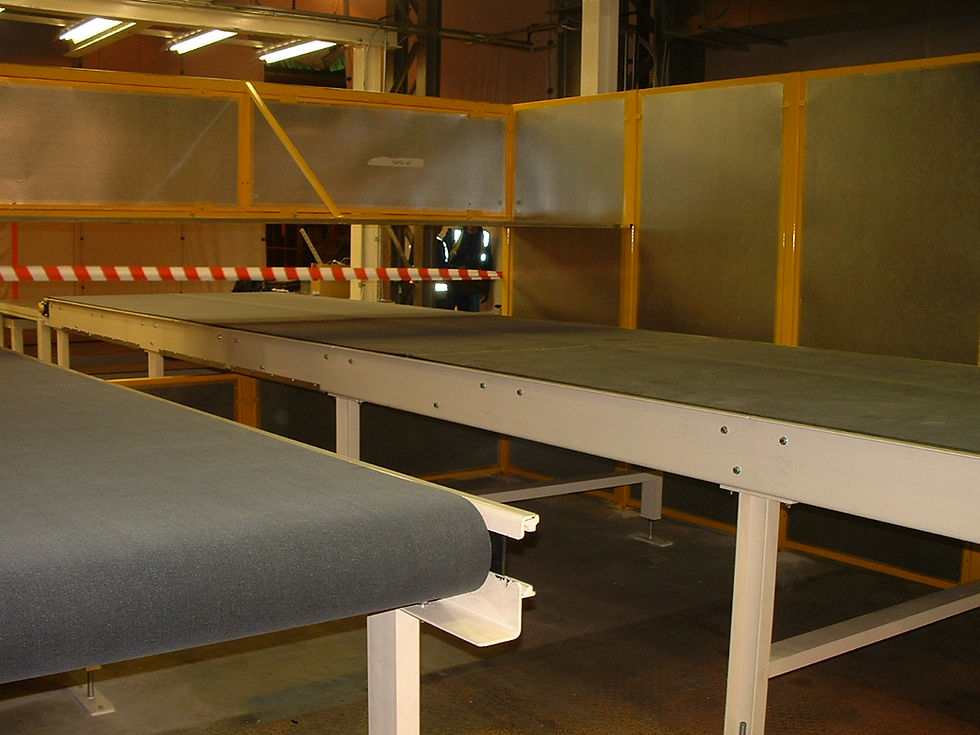
Mike Emerson, Managing Director of MJE Projects, began his engineering career with an apprenticeship at the Royal Ordnance Factory. That's not a biographical footnote. It's where the grounding came from: the engineering standards, the attention to tolerances, the understanding of what it actually means to build something that has to work reliably. When MJE's team designs and manufactures conveyor systems today, that lineage matters. It's the difference between an engineering firm that learned its trade in a serious environment and one that didn't.
What the City Is Building Now
The East Midlands manufacturing sector contributes around £24.7 billion to the regional economy and employs approximately 450,000 people. Those aren't heritage figures. That's the present day.
What's changed is the nature of the manufacturing itself. The region is in the middle of a genuine shift towards automation, digitalisation, and what people are now calling Industry 4.0. The Made Smarter East Midlands programme has seen over 300 businesses engage with digital transformation in manufacturing, with 38% already integrating digital solutions and 61% planning further investment in the near term. The University of Nottingham opened a dedicated Advanced Manufacturing Building, with a focus on AI, robotics, automation, and 3D printing. The East Midlands Investment Zone, announced to create over 4,300 jobs and leverage around £380 million of private investment over the next decade, has advanced manufacturing as one of its core pillars.
This isn't incidental. The East Midlands has the industrial base, the engineering culture, and the skills pipeline to compete in modern manufacturing in ways that not every UK region can. Nottingham Trent University now has an Automated Distribution and Manufacturing Centre specifically focused on bridging the gap between research and real-world industrial deployment.
The language is new. The underlying logic is exactly the same as it was when William Lee adapted his frame to produce lace net, or when Jesse Boot's workforce had to manufacture chemicals previously imported from Germany after the outbreak of the First World War. You work with what you have, you adapt to what the market needs, and you build capability that outlasts any individual product cycle.
Where MJE Fits In
MJE Projects designs and manufactures bespoke conveyor systems for businesses across food processing, packaging, e-commerce and industrial manufacturing. They're based in Kirkby in Ashfield, right in the heart of the Nottinghamshire manufacturing corridor, and they serve clients across the Midlands and beyond.
The connection to Nottingham's industrial tradition isn't marketing language. An ROF apprenticeship produces a particular kind of engineer: one who understands that the real test of any system is how it performs under load, in the real world, over time. MJE's approach to conveyor design and manufacture reflects that. Bespoke means genuinely bespoke, not a standard product with a few parameters adjusted.
If you're thinking about material handling and what automated systems can do for your production throughput, it's worth reading how Nottingham manufacturers are scaling with automated material handling. Or, if you're earlier in that decision-making process, a straightforward explanation of why a business might need a conveyor system is a decent starting point.
MJE's manufacturing sector page sets out what they actually offer for industrial clients, and the welcome post gives a sense of how they approach their work.
The Thread That Connects It
There's a tendency to treat industrial heritage as a kind of nostalgia exercise. Here's what used to be here, isn't it a shame, look at the lovely old factory buildings. But Nottingham's manufacturing story isn't really about what was lost. It's about what keeps getting rebuilt in new forms.
William Lee's stocking frame becomes the lace machine. The lace machine becomes the precision engineering culture that produces an ROF apprenticeship. The apprenticeship produces the engineer who founded a company that designs automated handling systems for the region's current wave of manufacturers. The East Midlands Investment Zone invests in the next generation of that capability.
The city has always made things. What it's making now is different from what came before, and in most respects considerably more sophisticated. But the underlying instinct, practical, adaptive, grounded in real mechanical understanding rather than theory, hasn't changed that much since a man from Calverton sat down to design a better way of knitting a stocking.
That's the heritage. And it's still very much at work.


Comments