
What are the advantages of using food & processing conveyors?
Conveyor belt systems are widely used in the food manufacturing industry. Not only is it much more efficient than manual labour, but it also ends up being much less expensive in the long term. Food production must adhere to stringent laws, and the methods used to produce various foods vary substantially.
What functions with raw meats may not be suitable for baked goods, and understanding what works best for your company’s needs is crucial to maximising profits and reducing downtime. One of the main things you’ll need to consider is the type of conveyor system used, as quality and performance can greatly vary across plastic modular belt conveyors, slat conveyors, honeycomb belt conveyors, belt conveyors, rotary accumulation tables, and pallet roller conveyors.. Each of these systems offers unique benefits tailored to hygiene, temperature control, flexibility, and sustainability in food processing environments. This is why.
Food & processing conveyors are designed for easy sanitation.

A recall is a major problem for those who work in the food production business. It may not only be incredibly expensive, but it may also irreversibly ruin a manufacturer's reputation. This means that all of your equipment must be simple to maintain and able to withstand the demanding conditions frequently brought on by sanitation procedures used in an industrial setting. Plastic modular belt conveyors feature smooth, non-porous surfaces and open-hinge designs that allow thorough washdown and prevent bacterial buildup. Slat conveyors and honeycomb belt conveyors offer open structures ideal for drainage and cleaning, while rotary accumulation tables enable full-access cleaning from all angles. These systems support high-pressure washdowns and CIP (clean-in-place) processes without degradation.
Food & processing conveyors handle extreme temperature variation with ease.
In addition to sanitation, temperature resilience is critical in food processing. Applications may involve baking, freezing, cooling, or pasteurisation. Plastic modular belt conveyors use engineered thermoplastics (such as polypropylene or acetal) that resist thermal shock and operate reliably from -40°C to +90°C or higher depending on material. Honeycomb belt conveyors provide excellent airflow for rapid cooling or drying, while pallet roller conveyors in secondary packaging zones maintain structural integrity in chilled or ambient environments. These systems prevent warping, cracking, or deformation under thermal stress.
Food & processing conveyors support sustainable operations.
Although almost all manufacturing processes leave a carbon footprint, modern food & processing conveyors prioritise eco-friendly design. Plastic modular belts are made from recyclable, FDA-approved polymers with lower energy demands during production compared to traditional materials. Slat and honeycomb designs reduce weight and friction, lowering energy consumption during operation. Rotary tables and pallet roller conveyors optimise space and flow, reducing unnecessary transport and packaging waste—contributing to leaner, greener production lines.

Food & processing conveyors offer exceptional operational flexibility.
There is a tailored conveyor solution for every challenge in the food manufacturing process. Plastic modular belt conveyors allow tool-free assembly and reconfiguration, ideal for changing product sizes or layouts. Honeycomb belt conveyors excel in drainage-heavy applications like washing or dewatering produce. Rotary accumulation tables manage product buffering during downstream delays, preventing backups. Pallet roller conveyors streamline secondary packaging with powered or gravity-fed movement, while belt conveyors with variable speed control adapt to gentle handling of delicate items. These systems support tight turns, inclines, and integration with automation—reducing manual intervention and improving throughput.
Conveyor systems can be designed and supplied in any width, length, or configuration.
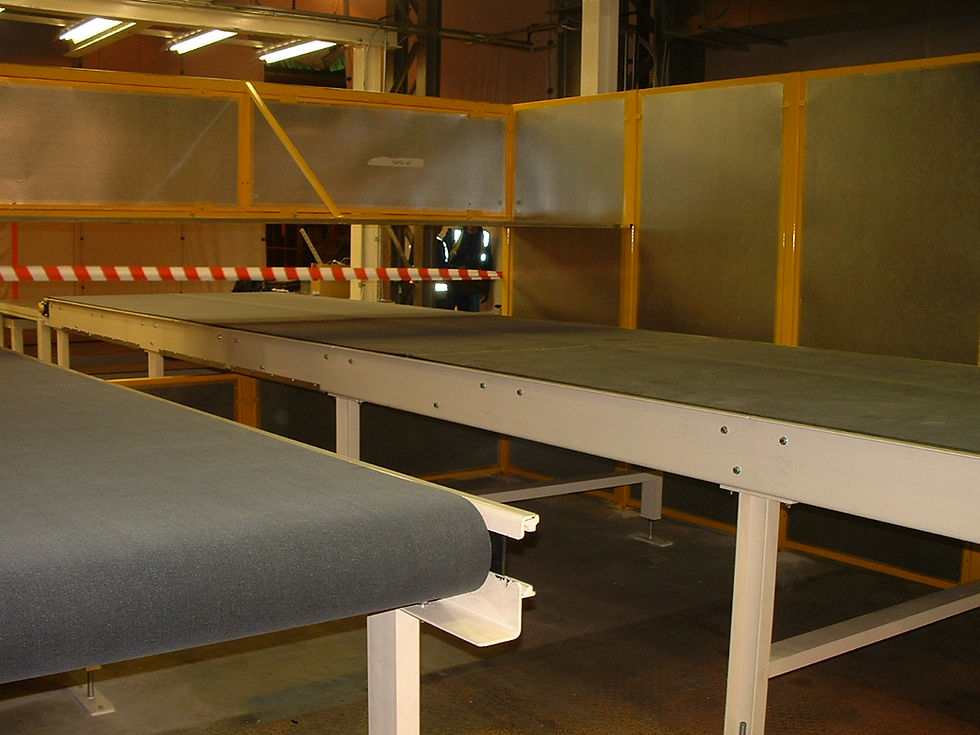
Whether you're handling fresh produce, baked goods, frozen items, or packaged products, MJE Projects has the food & processing conveyor solution for you.


Comments